
If you drive in Gurnee during winter, you already know how this story starts.
It’s early. The
air hurts your face. You scrape ice off the windshield, hop into your car, and
just as you’re about to head out... boom. There it is. That glowing orange
horseshoe with the exclamation point. The TPMS light.
At this point, it’s basically a winter tradition. Right up there with
freezing hands at the gas pump and questioning why you didn’t park closer at
Gurnee Mills. What’s happening? Your tires didn’t magically go bad overnight.
Why now? Because Gurnee winters don’t mess around, and cold air loves sneaking
out of your tires. When should you worry? Before low pressure starts affecting
your braking, traction, and fuel efficiency, especially on icy stretches of
Route 21 or during a sudden temperature drop off Lake Michigan.
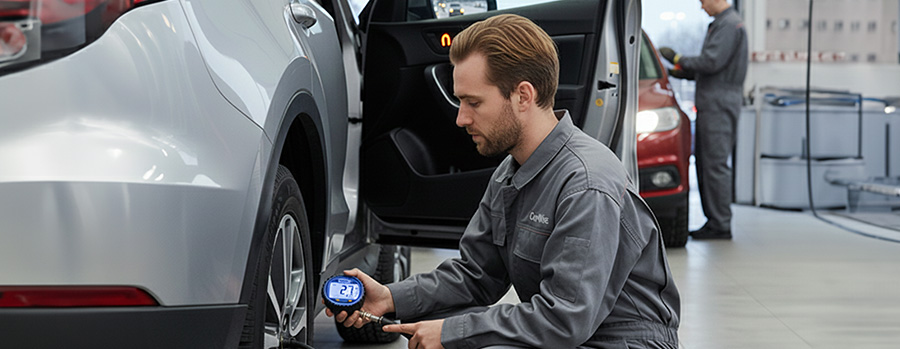
Here’s the good news: that warning light isn’t a sign of mechanical doom. It’s more like your car quietly tapping you on the shoulder and saying, "Hey, it’s cold. Your tires are feeling it.” In this guide, we’ll decode what that TPMS light really means in winter, explain why tire pressure drops when temperatures do, and show you exactly when and how to adjust it without stress. By the time you’re done reading, you’ll know how to keep your tires (and your winter plans) rolling smoothly, no matter how cold Gurnee gets.
Tire pressure is simply the amount of air inside your tire, measured in
PSI (pounds per square inch). It is, quite literally, the only thing connecting
your vehicle to the asphalt. When that connection is wrong, your car feels
sloppy, like trying to walk on ice while wearing socks.
Think of tire pressure like hydration for your car:
·
Too little air and your tires feel sluggish and heavy
·
Too much air and they’re stiff, jumpy, and uncomfortable
On a warm summer day, tire pressure feels confident - kind of like
walking into Portillo’s knowing exactly what you’re ordering. Winter, though,
is a different story.
Cold air causes air molecules inside your tires to slow down and
contract. When that happens, PSI drops - sometimes dramatically. That’s why low
tire pressure in winter is so common, even if everything was fine just days
ago.
Here’s the key number every Gurnee driver should know: For every 10°F
drop in temperature, your tires lose about 1 PSI. So, when Gurnee goes from a
mild 50°F afternoon to a "why do I live here?” 10°F morning overnight, your
tires can lose 3-4 PSI while you sleep.
No leaks. No damage. Just winter doing winter things.
There isn’t a special "winter PSI” setting, but there is a big
seasonal difference in how tire pressure behaves.
· Summer: Heat causes PSI to rise naturally
· Winter: Cold causes PSI to drop - sometimes fast
This is why tire pressure summer vs winter feels so different even
though the recommended number stays the same.
In Gurnee, where temperatures can swing wildly in a single week, tire
pressure becomes a moving target. Cold mornings near Hunt Club Road or
Washington Street can drop PSI by several points without warning. That’s why
winter tire pressure needs more attention, not different numbers.
While every vehicle has its own exact PSI, here are typical ranges to
help Gurnee drivers know what’s normal during winter:
|
Vehicle Type
|
Typical PSI (All Seasons)
|
Winter Notes
|
|
Compact Cars (Civic, Corolla)
|
30-33 PSI
|
Pressure drops fast in extreme cold
|
|
Sedans (Camry, Accord)
|
32-35 PSI
|
Maintain factory PSI for winter grip
|
|
Crossovers (RAV4,
CR-V)
|
35-36 PSI
|
Cold mornings may drop PSI by 2-3
|
|
SUVs (Highlander, Explorer)
|
35-38 PSI
|
Stable PSI improves snow traction
|
|
Pickup Trucks (F-150, Ram)
|
38-45 PSI
|
Follow load-based guidelines
|
|
Minivans (Sienna, Odyssey)
|
35-36 PSI
|
Ideal for Gurnee-to-Chicago drives
|
|
Performance Cars
|
32-38 PSI
|
Sensitive to cold; check often
|
The great news is that you don’t need
tools from NASA or a mechanic’s certification to check your tire pressure. You
can do it right in your driveway in Grandwood Park or by Six Flags using
a simple digital gauge.
·
Stick it on the valve stem.
·
Get the number.
·
Compare to recommended PSI.
Done.
You’ll find them at:
·
Speedway (an all-time favorite)
·
BP near Washington Street
·
Thorntons (ideal for late-night "my
tire light is on again” emergencies)
Most stations offer free or low-cost
air.
We check your PSI, fill your tires, and
make sure your winter tire pressure is stable - no guesswork.
Pro Tip: Always check tire pressure when tires are cold. Running errands
from Target to Aldi to Gurnee Mills warms your tires and gives incorrect
readings.
Winter in Gurnee isn’t subtle - and your tires feel every bit of it. The
biggest factors affecting winter tire pressure include:
·
Sudden temperature drops
·
Cold air contracting inside tires
·
Frost and ice buildup around rims
·
Short drives that don’t warm tires enough
·
Tiny leaks that worsen in cold weather
·
Infrequent pressure checks
Most drivers don’t notice a problem until the warning light comes on -
and by then, PSI is already low.
Let’s talk solutions - and how drivers
around Grand Avenue, Hunt Club Road, O’Plaine Road, and Waveland can
keep their PSI in check.
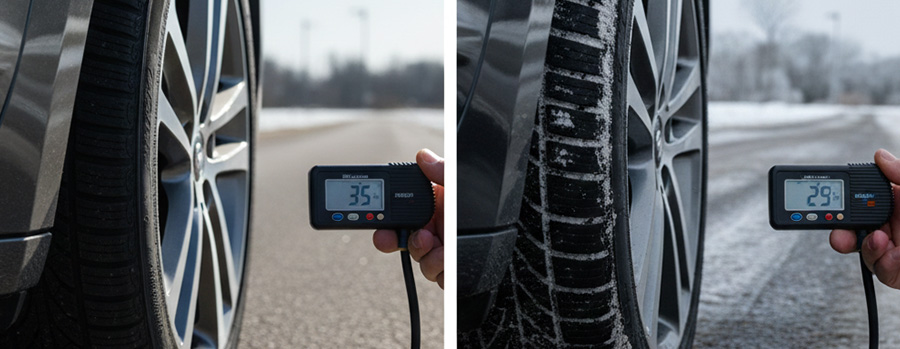
To truly win the battle against the blinking light, adopt these habits:
1. The Weekly Appointment: You check the weather forecast weekly, right? Add your tires to the list. They are a barometer for the week’s temperature swings.
2. The Danger of the Drop: Driving on low PSI is not just inefficient; it’s dangerous. Underinflated tires flex more, generating heat that leads to premature wear, and they offer a sloppy, less controlled contact patch on slippery ice.
3. Defeating the Overinflation Myth: This is the story people tell themselves: "I'll put in an extra 5 PSI, so the cold can’t steal it all." Don't do it. Overinflating makes the tire stiff, concentrates wear in the center, and drastically reduces your vital traction on a sheet of black ice. Stick to the factory number.
4. Listen to the Story of the Lone Tire: If three tires are at 32 PSI and the fourth is at 25 PSI, you have a leak. It’s telling you a story of a recent nail encounter or a failing valve stem. It’s time to visit us.
Winter driving in Gurnee already comes with icy roads, surprise
snowfalls, and the daily ritual of scraping your windshield. Your tire pressure
shouldn’t add to the stress. By understanding winter tire pressure, knowing
what your tire pressure should be in winter, and maintaining the correct winter
tire PSI, you keep your car smoother and more predictable all season long.
And if that tire pressure light keeps glowing like the holiday displays
at Gurnee Mills?
Just swing by CarWise Gurnee.
We’ll check your
PSI, adjust your tires to the ideal winter tire pressure, and send you back on
the road before you finish shopping at Gurnee Mills.